
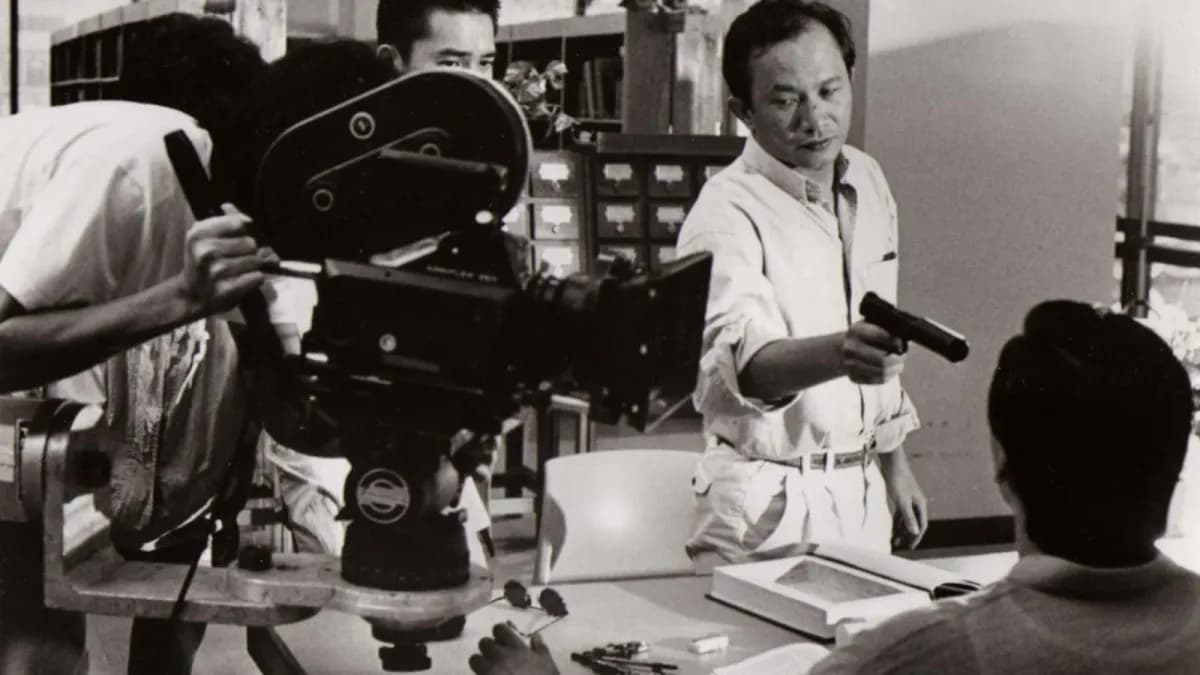
John Woo is the poet of action cinema. His films aren't just shootouts—they're rituals, elegies about honor, brotherhood, and the tragic inevitability of fate, wrapped in cascades of bullets, smoke, and white doves.
For many of us, John Woo means Saturday night. The world outside ceases to exist. Chips on the table, someone murmurs in the background, and on screen another ceremonial firefight begins. Time slows. Bullets fly in slow motion, as if each one carries its own story, regret, decision, destiny.
This isn't cinema for intellectual analysis from a critic's armchair. This is cinema for being together, for winding down after the week, for that mindless (yet deeply conscious) surrender to pure, stylish escapism until 3 a.m.
A Style That Doesn't Apologize
John Woo never pretended to make anything other than what he wanted. His cinema has to be cool—in the same way wearing a long coat, dual-wielding pistols, and throwing one glance that says everything was cool for a ten-year-old. As an adult, you still buy it.
Sometimes one well-made kung-fu film or heroic bloodshed says more about the human condition than several arthouse dramas about relationship breakdowns.
Woo's sense of style is absolute.
- Transitions between shots are fluid, layered with fades and overlaps that add a poetic touch.
- Slow-motion isn't for show—time thickens, action gains weight.
- Frames are full and balanced—violence becomes choreography.
This isn't flashiness for its own sake. It's language.
Heroic Bloodshed – Blood for Higher Values
Woo's golden era was the late 80s and early 90s—the peak of Hong Kong action cinema. That's when films defining the heroic bloodshed genre were born.
- A Better Tomorrow (1986) – brotherhood, betrayal, redemption through blood.
- The Killer (1989) – Chow Yun-fat as the tragic assassin who wants to quit but honor won't let him.
- Hard Boiled (1992) – operatic escalation of violence in cops vs. gangs warfare.
Chow Yun-fat is the perfect actor for Woo. Charisma, elegance, inner conflict written on his face. Woo's heroes are archetypes: the loyal killer, tragic cop, man with a code. Formulaic? Yes. That's the point. The formula carries the myth.
Red Cliff, or Myth More Important Than Facts
In Red Cliff (2008), John Woo returns to China and reaches for the classic myth of the Battle of Red Cliffs. To Western eyes, the film feels like 4D chess—heroes seem almost omniscient, yet tension never fades.
And that's what got me thinking. In Chinese tradition, is history primarily a record of facts—an attempt at faithfully reconstructing 'what happened'? Western civilization, from Thucydides and Plato through Kant to today, made truth-seeking (aletheia) its goal. Meanwhile, in China, history was often treated as a tool for moral education—a gallery of archetypes.
Chinese historiography sometimes attributed one ruler's deeds to another to preserve archetypal consistency and world harmony. What mattered wasn't so much what 'really' happened, but what aligned with the Dao. Truth was often less important than harmony.
Woo doesn't reconstruct the battle like a documentarian. He tells a myth. The director himself said Red Cliff is '50% factual'—it wasn't about chronicle, but capturing the spirit of events in epic action cinema.
Heroes are archetypes, battles are ballets, and the whole thing smells of an older, cosmic order.
Why It Still Works
Because John Woo never apologized for his vision. His films are naive, campy, over-the-top—and that's why they have this strange elegance. Violence becomes poetry.
On a Saturday night, with a bag of chips and a few people on the couch, the world slows with the film's frames. And for a moment, you're not just watching action. You're witnessing a fragment of larger order where honor and brotherhood mean more than any realistic reconstruction.
John Woo doesn't make movies. He writes poems.